

Bengamin Morrill Banjo Clock, circa 1820-1830, Restored by Master Clocksmith
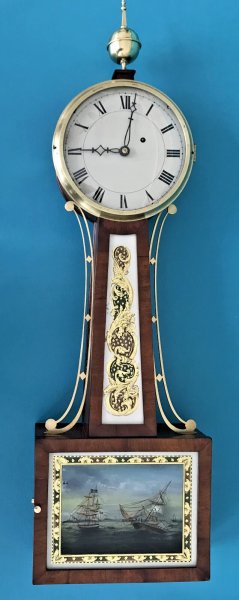
Bengamin Morrill Banjo Clock, circa 1820-1830, Restored by Master Clocksmith
SOLD $1,650.00 Sold: May 16, 2025 on eBayOriginal Listing Description
This 8-day weight driven banjo clock is an excellent example made by Benjamin Morrill (1794 - 1857) and would be dated circa 1820-1830. The clock has been professionally restored by a master clocksmith.Provenance background:There are no maker signature or marks on this clock. The key to identifying the maker of the clock then revolves around the movement, pendulum rod, and case features. NH and VT banjo clock makers incorporated some unique features in their movements and pendulum rods over their contemporary clock makers in MA. These features include: arched cut outs on the lower side of the front & rear movement plates, Curtis style suspension hanger, C-shape bent wire pendulum rod which avoided the need of a keystone, a lower box catch button spring anchored by a screw from the outside rather than on the inside of the box, and other than diamonds between the rails of the sidearms. These makers included Benjamin Morrill, Abiel Chandler, and Levi Hutchins. The C-shape pendulum rod presents a design requirement for the pendulum bob that it cannot be allowed to twist about the rod else there would be lost energy in the pendulum and interference collision with the hour gear and weight shield. The solution was realized by flattening the rod where it passed through the bob. Because the flattened width is not much more than twice the rod diameter, the lead of the bob must be hammered to remove all gap around the flattened rod. The cast iron dial was restored by the Dial House, but they had nothing in their notes as to the dial having been signed when received. Banjo clock cases also carry unique features between the different NH and VT clock makers. A signed Bengamin Morrill banjo clock, as shown on Live Auctioneers on 4-1-2023, has an exact match to this case's interior and movement that includes the following: ** Movement and pendulum rod/bob ** Diamonds between the sidearm rails ** Cast brass dial bezel shape, glass retention tabs, hinge, and locking post. Dial glass is flat and appears to be original. ** Bezel latch release is mounted exterior to the case ** Throat tablet frame is narrower and shorter than used by Willard and similar banjo clocks ** Lower box door latch is a push button whose anchor is a flat head screw from the outside of the case. Typically, the latch post is a flat head screw that has been shaped to contain the locking notch needed by the latch. In this clock the latch post has a brass knob head instead of being a flat head screw because the taper angle of the screw head would challenge the adhesion stability of the veneer. The latch post and knob are new.Clock details:While these clock makers had many common elements in the movement design, the hands appear to be uniquely different for each maker and can be identified in the book 'New Hampshire Clock & Clockmakers' by Parsons. These hands are matched on pg.177, figure301. The tablets on this clock are sized differently than on the MA made clocks particularly for the shortened and narrow throat. These tablets came from a set of gilded frame/tablets purchased at an earlier time on eBay and were fitted into the throat and lower tablet frames. They are contemporary to the age of this clock.The case is made of mahogany and mahogany veneers. The one-piece backboard is original. The bottom section was rebuilt at some time in the past. It is not unusual for the cable supporting the weight to break - sending the weight crashing through the bottom especially when in the olden days the cord was made from cat gut. The sides appear to be the original wood with the bottom glue blocks and base board having been replaced. The number 'XVI' is carved in the throat section and could mean the case was one of a lot of 16 or the case was made in 1816. The newer base board shows no indication that a pedestal was ever attached. It is clear that the movement is the only one that has ever been mounted within this case. Case is medium stained mahogany stained and finished with many coats of shellac followed by a modified French polish to bring out the shine and depth of the wood grain. All brass fittings are polished and clear coated with lacquer. The hands are cold blackened. Weight is cast iron, Weight stop has been modified from a screw to a screw retained wedge block that prevents the screw from being pulled out of the backboard. Key is included.Collectively, this banjo clock is a fine example by Bengamin Morrill and a historic timepiece that will grace your home or office with ageless sophistication.Clock will be double cardboard boxed with the weight outside of the inner cardboard box containing the clock.Dimensions of clock: 29.5" high + 4.5"finial x 10.25" wide x 3.75" deepWeight of clock: 15 lb, 1ozShipping: Clock will be shipped in a custom crafted reusable wooden crate which is designed to last another 100 years. It will then be packed within a padded cardboard box. This insures the clock may be safely delivered to you and, can be moved in the future, if needed. Integral chambers ensure the weight, pendulum bob, eagle, and key cannot get loose and cause damage to the clock. The clock itself is wrapped in de-acidified tissue paper over a thin polyurethane foam wrap and floated within the box by polyurethane foam blocks and sheets. This option is a good solution for those who know they will be moving often or as a way to ensure the clock can be safely passed down to family members. Instructions are included for the packing of the clock within the crate and reassembly later. An example of the crate is shown in the pictures. It can be made as either 1x2 trimmed plywood panels or pine box sides with plywood top/bottom panels. The panels and gusset plates are glued and screwed together with only the top panel being removable. As an aside, if transporting the clock as luggage on a plane you need to separate the dial and weight shield from the case so that it can be easily reviewed by TSA else you will cause quite the commotion and significant delay in getting to your flight. As you can see in the example crate photos, the dial and weight shield are packed on the top just under the top crate panel. I say this from my own experience.Please see pictures as they are an integral part of the description. Please feel free to contact me with any questions you might have before purchasing or bidding.Packed with care for a worry-free safe delivery. Ship cost includes tracking and full insurance coverage. (Condition: Refurbished)
Note: This item has been sold and is no longer available. This page serves as a historical price reference for clocks collectors and appraisers.
Original Listing Description
This 8-day weight driven banjo clock is an excellent example made by Benjamin Morrill (1794 - 1857) and would be dated circa 1820-1830. The clock has been professionally restored by a master clocksmith.Provenance background:There are no maker signature or marks on this clock. The key to identifying the maker of the clock then revolves around the movement, pendulum rod, and case features. NH and VT banjo clock makers incorporated some unique features in their movements and pendulum rods over their contemporary clock makers in MA. These features include: arched cut outs on the lower side of the front & rear movement plates, Curtis style suspension hanger, C-shape bent wire pendulum rod which avoided the need of a keystone, a lower box catch button spring anchored by a screw from the outside rather than on the inside of the box, and other than diamonds between the rails of the sidearms. These makers included Benjamin Morrill, Abiel Chandler, and Levi Hutchins. The C-shape pendulum rod presents a design requirement for the pendulum bob that it cannot be allowed to twist about the rod else there would be lost energy in the pendulum and interference collision with the hour gear and weight shield. The solution was realized by flattening the rod where it passed through the bob. Because the flattened width is not much more than twice the rod diameter, the lead of the bob must be hammered to remove all gap around the flattened rod. The cast iron dial was restored by the Dial House, but they had nothing in their notes as to the dial having been signed when received. Banjo clock cases also carry unique features between the different NH and VT clock makers. A signed Bengamin Morrill banjo clock, as shown on Live Auctioneers on 4-1-2023, has an exact match to this case's interior and movement that includes the following: ** Movement and pendulum rod/bob ** Diamonds between the sidearm rails ** Cast brass dial bezel shape, glass retention tabs, hinge, and locking post. Dial glass is flat and appears to be original. ** Bezel latch release is mounted exterior to the case ** Throat tablet frame is narrower and shorter than used by Willard and similar banjo clocks ** Lower box door latch is a push button whose anchor is a flat head screw from the outside of the case. Typically, the latch post is a flat head screw that has been shaped to contain the locking notch needed by the latch. In this clock the latch post has a brass knob head instead of being a flat head screw because the taper angle of the screw head would challenge the adhesion stability of the veneer. The latch post and knob are new.Clock details:While these clock makers had many common elements in the movement design, the hands appear to be uniquely different for each maker and can be identified in the book 'New Hampshire Clock & Clockmakers' by Parsons. These hands are matched on pg.177, figure301. The tablets on this clock are sized differently than on the MA made clocks particularly for the shortened and narrow throat. These tablets came from a set of gilded frame/tablets purchased at an earlier time on eBay and were fitted into the throat and lower tablet frames. They are contemporary to the age of this clock.The case is made of mahogany and mahogany veneers. The one-piece backboard is original. The bottom section was rebuilt at some time in the past. It is not unusual for the cable supporting the weight to break - sending the weight crashing through the bottom especially when in the olden days the cord was made from cat gut. The sides appear to be the original wood with the bottom glue blocks and base board having been replaced. The number 'XVI' is carved in the throat section and could mean the case was one of a lot of 16 or the case was made in 1816. The newer base board shows no indication that a pedestal was ever attached. It is clear that the movement is the only one that has ever been mounted within this case. Case is medium stained mahogany stained and finished with many coats of shellac followed by a modified French polish to bring out the shine and depth of the wood grain. All brass fittings are polished and clear coated with lacquer. The hands are cold blackened. Weight is cast iron, Weight stop has been modified from a screw to a screw retained wedge block that prevents the screw from being pulled out of the backboard. Key is included.Collectively, this banjo clock is a fine example by Bengamin Morrill and a historic timepiece that will grace your home or office with ageless sophistication.Clock will be double cardboard boxed with the weight outside of the inner cardboard box containing the clock.Dimensions of clock: 29.5" high + 4.5"finial x 10.25" wide x 3.75" deepWeight of clock: 15 lb, 1ozShipping: Clock will be shipped in a custom crafted reusable wooden crate which is designed to last another 100 years. It will then be packed within a padded cardboard box. This insures the clock may be safely delivered to you and, can be moved in the future, if needed. Integral chambers ensure the weight, pendulum bob, eagle, and key cannot get loose and cause damage to the clock. The clock itself is wrapped in de-acidified tissue paper over a thin polyurethane foam wrap and floated within the box by polyurethane foam blocks and sheets. This option is a good solution for those who know they will be moving often or as a way to ensure the clock can be safely passed down to family members. Instructions are included for the packing of the clock within the crate and reassembly later. An example of the crate is shown in the pictures. It can be made as either 1x2 trimmed plywood panels or pine box sides with plywood top/bottom panels. The panels and gusset plates are glued and screwed together with only the top panel being removable. As an aside, if transporting the clock as luggage on a plane you need to separate the dial and weight shield from the case so that it can be easily reviewed by TSA else you will cause quite the commotion and significant delay in getting to your flight. As you can see in the example crate photos, the dial and weight shield are packed on the top just under the top crate panel. I say this from my own experience.Please see pictures as they are an integral part of the description. Please feel free to contact me with any questions you might have before purchasing or bidding.Packed with care for a worry-free safe delivery. Ship cost includes tracking and full insurance coverage. (Condition: Refurbished)
Note: This item has been sold and is no longer available. This page serves as a historical price reference for clocks collectors and appraisers.