

Antique Edo Period Japanese Inro Watch / Clock & Sundial / Compass 1700s RARE
Antique Edo Period Japanese Inro Watch / Clock & Sundial / Compass 1700s RARE
SOLD $5,999.00 Sold: Sep 30, 2023 on eBayOriginal Listing Description
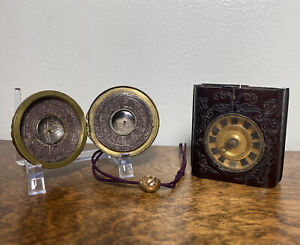
This listing is for an antique extremely rare Edo-period. Japanese gilt-brass mounted shitan wood watch (INRO-DOKEI). It is an exquisite piece, with a carved wooden case, and a beautifully carved metal movement; along with an extraordinary compass / sundial that has a case made of mokume-gane. It is likely from the late Edo Period, from what my research can find. I am unsure the exact year of its manufacture, but it appears to be potentially mid to late 1700s to early 1800s. A Japanese version of a portable compact watch in a casing resembling a pillbox, along with its compass. I have not been able to narrow down a maker yet, but it appears that the golden bead attached to the compass has both a potential signature and an exquisite lotus flower. These pieces were made before any sort of standardized time that we are used to, so the compass & sundial were integral for helping to keep your clock keep time while out & about. Japanese Inro clock-watches & their compass/ sundials of this caliber do not come often, especially not on ebay. Usually these are tied up in big-name auctions, with high buyer-premiums & extra fees; so grab this one now while you can!It appears to be in working condition, however I have not fully wound it up, due to my lack of experience with clocks of this kind. It appears to wind and run just fine though, there do not seem to be any broken mechanics, and the chain is complete and seemingly mint. I have not applied any oil or taken it apart in any way (other than sliding it out of the wooden case) so as not to cause damage. It is as-found, but in excellent condition. The curved rectangular case with its glass has an amazingly detailed hand carved design. The front has some filigree & leaved, the back displays two monks, or a monk & a god, playing some version of checkers under a blossoming tree. As you can see, the case has cracked in two during some point in its life. It seems that it could be delicately glued & restored to one whole unit, but I have not done so, as I do not know the correct glue to use. It may also be missing a metal bezel for the glass, but the glass is not loose. Restoration is up to buyers preferences. I am not sure if there were originally any top or bottom wooden panels held in place by the cord that are now lost. Comes with all the casing pieces shown. The metal front plate is engraved with leafy branches, the number panels, which can be slid depending on the time of year appear to be hand carved. The single chain fusee movement with verge escapement and plain balance with pierced and engraved bridgecock, with backplate with balance regulation scale and engraved with floral branches. It has a cord terminating with the engraved copper Damascus drum-shaped netsuke, opening to reveal a silver compass and sundial. It has its original gilt lacquer or potentially even gold, bead; an ojime. If you look in the carved copper body of the compass you can see the Mokume-gane (???) which it is made of. It is a Japanese metalworking procedure which produces a mixed-metal laminate with distinctive layered patterns; the term is also used to refer to the resulting laminate itself. The term mokume-gane translates closely to "wood grain metal" or "wood eye metal" and describes the way metal takes on the appearance of natural wood grain.[1] Mokume-gane fuses several layers of differently coloured precious metals together to form a sandwich of alloys called a "billet." To the best I can tell, that is what this compass case is made of, though besides copper I am unsure the metals used. The loop to hold the thread & its embossed attachment piece, as well as the compass & sundial faces may be silver, but I am not sure. I have not tested any of the metal content at all, to not damage it. The dial has adjustable silvered engraved characters which represent the time as indicated by the hand. I believe the characters are two sequences of nine to four with the zodiac symbols used for the nine to represent noon and midnight. At the end of the Edo Period, pendulums and balance springs started to be used in speed regulators. Because it was difficult to adjust the time variations of both the four seasons and day and night mechanically, a hand-rotated dial of numbers that changed the time interval was conceived. The small rotating dial is engraved with text for 12 periods of time (the 12 signs of the Chinese zodiac or numbered hours from 9 to 4). Japanese traditional clocks mainly in the Edo period that conformed to the temporal hour system developed uniquely in Japan, drawing attention from researchers in the world, and being highlighted in foreign books and studied. These clocks are highly sought after, many are on display in museums or locked away in private collections, but few are ever for sale.This clock comes from a massive estate collection, and was extremely well cared for in a temperature controlled room. Please check back this weekend & next week for multiple other antique & unique clocks I will be listing!Thank you for your consideration, reasonable offers are always considered. Please see photos for details & measurements, comes as shown- “lightly/semi tested”. Description is based upon research available. With any clock, this one may require set up and/or adjustment after shipment, however rest assured it will be packaged with extreme care suitable for such a quality item.(Please note- Shipping is within the US, lower 48 states, only. No exceptions. Item must be paid for within 4 days of purchase, unless arranged otherwise, or your order will be cancelled & relisted. )(Please note- Shipping is within the US, lower 48 states, only. No exceptions. )Please feel free to read on below for a brief history of clocks in Japan, courtesy of the Japan Clock & Watch Association’s remarkably informative site: As Christianity spread in Japan, missionaries established vocational schools affiliated with churches in Kyushu and Kyoto. In addition to print technology, organs, and astronomical instruments, these schools taught production techniques for clocks. Japanese blacksmiths manufactured clocks under the guidance of these schools, resulting in the first mechanical clock production in Japan.According to the "Owari-shi" (a periodical from the Owari territory) compiled in 1832, Sukezaemon Tsuda from Nagoya City repaired a clock belonging to Ieyasu Tokugawa, and then used it as a model to create a new clock, which he offered to Ieyasu. For his service, Sukezaemon Tsuda was employed by Ieyasu in 1598. However, the shogunate government soon banned Christianity and adopted a policy of seclusion, which blocked the flow of new technology from Europe. Thus, it was possible to come in contact with cultural items from places such as China and Holland through Nagasaki only, and this also affected Japanese traditional clock production Clock makers gradually increased around the country, with many working as personal clock makers for the shogunate family and feudal lords for whom they were making gorgeous articles. Japanese traditional clock production sites included first and foremost Nagasaki, as well as Matsue, Kyoto, Osaka, Sakai, Ise, Nagoya, Wakasa, Edo, Sendai, Morioka, and Hirosaki.In Europe, mechanical clocks appeared as timekeeping switched from a variable to fixed method, but Japan at that time used a unique temporal hour system. As a result, clock production basically remained a copy of early European methods. Rather than work to increase the precision of clocks, Japanese clock makers focused on creativity and originality to conform to the country's unique temporal hour system. This resulted in the development of unique Japanese traditional clocks not seen elsewhere. (Condition: Pre-Owned)
Note: This item has been sold and is no longer available. This page serves as a historical price reference for clocks collectors and appraisers.
Original Listing Description
This listing is for an antique extremely rare Edo-period. Japanese gilt-brass mounted shitan wood watch (INRO-DOKEI). It is an exquisite piece, with a carved wooden case, and a beautifully carved metal movement; along with an extraordinary compass / sundial that has a case made of mokume-gane. It is likely from the late Edo Period, from what my research can find. I am unsure the exact year of its manufacture, but it appears to be potentially mid to late 1700s to early 1800s. A Japanese version of a portable compact watch in a casing resembling a pillbox, along with its compass. I have not been able to narrow down a maker yet, but it appears that the golden bead attached to the compass has both a potential signature and an exquisite lotus flower. These pieces were made before any sort of standardized time that we are used to, so the compass & sundial were integral for helping to keep your clock keep time while out & about. Japanese Inro clock-watches & their compass/ sundials of this caliber do not come often, especially not on ebay. Usually these are tied up in big-name auctions, with high buyer-premiums & extra fees; so grab this one now while you can!It appears to be in working condition, however I have not fully wound it up, due to my lack of experience with clocks of this kind. It appears to wind and run just fine though, there do not seem to be any broken mechanics, and the chain is complete and seemingly mint. I have not applied any oil or taken it apart in any way (other than sliding it out of the wooden case) so as not to cause damage. It is as-found, but in excellent condition. The curved rectangular case with its glass has an amazingly detailed hand carved design. The front has some filigree & leaved, the back displays two monks, or a monk & a god, playing some version of checkers under a blossoming tree. As you can see, the case has cracked in two during some point in its life. It seems that it could be delicately glued & restored to one whole unit, but I have not done so, as I do not know the correct glue to use. It may also be missing a metal bezel for the glass, but the glass is not loose. Restoration is up to buyers preferences. I am not sure if there were originally any top or bottom wooden panels held in place by the cord that are now lost. Comes with all the casing pieces shown. The metal front plate is engraved with leafy branches, the number panels, which can be slid depending on the time of year appear to be hand carved. The single chain fusee movement with verge escapement and plain balance with pierced and engraved bridgecock, with backplate with balance regulation scale and engraved with floral branches. It has a cord terminating with the engraved copper Damascus drum-shaped netsuke, opening to reveal a silver compass and sundial. It has its original gilt lacquer or potentially even gold, bead; an ojime. If you look in the carved copper body of the compass you can see the Mokume-gane (???) which it is made of. It is a Japanese metalworking procedure which produces a mixed-metal laminate with distinctive layered patterns; the term is also used to refer to the resulting laminate itself. The term mokume-gane translates closely to "wood grain metal" or "wood eye metal" and describes the way metal takes on the appearance of natural wood grain.[1] Mokume-gane fuses several layers of differently coloured precious metals together to form a sandwich of alloys called a "billet." To the best I can tell, that is what this compass case is made of, though besides copper I am unsure the metals used. The loop to hold the thread & its embossed attachment piece, as well as the compass & sundial faces may be silver, but I am not sure. I have not tested any of the metal content at all, to not damage it. The dial has adjustable silvered engraved characters which represent the time as indicated by the hand. I believe the characters are two sequences of nine to four with the zodiac symbols used for the nine to represent noon and midnight. At the end of the Edo Period, pendulums and balance springs started to be used in speed regulators. Because it was difficult to adjust the time variations of both the four seasons and day and night mechanically, a hand-rotated dial of numbers that changed the time interval was conceived. The small rotating dial is engraved with text for 12 periods of time (the 12 signs of the Chinese zodiac or numbered hours from 9 to 4). Japanese traditional clocks mainly in the Edo period that conformed to the temporal hour system developed uniquely in Japan, drawing attention from researchers in the world, and being highlighted in foreign books and studied. These clocks are highly sought after, many are on display in museums or locked away in private collections, but few are ever for sale.This clock comes from a massive estate collection, and was extremely well cared for in a temperature controlled room. Please check back this weekend & next week for multiple other antique & unique clocks I will be listing!Thank you for your consideration, reasonable offers are always considered. Please see photos for details & measurements, comes as shown- “lightly/semi tested”. Description is based upon research available. With any clock, this one may require set up and/or adjustment after shipment, however rest assured it will be packaged with extreme care suitable for such a quality item.(Please note- Shipping is within the US, lower 48 states, only. No exceptions. Item must be paid for within 4 days of purchase, unless arranged otherwise, or your order will be cancelled & relisted. )(Please note- Shipping is within the US, lower 48 states, only. No exceptions. )Please feel free to read on below for a brief history of clocks in Japan, courtesy of the Japan Clock & Watch Association’s remarkably informative site: As Christianity spread in Japan, missionaries established vocational schools affiliated with churches in Kyushu and Kyoto. In addition to print technology, organs, and astronomical instruments, these schools taught production techniques for clocks. Japanese blacksmiths manufactured clocks under the guidance of these schools, resulting in the first mechanical clock production in Japan.According to the "Owari-shi" (a periodical from the Owari territory) compiled in 1832, Sukezaemon Tsuda from Nagoya City repaired a clock belonging to Ieyasu Tokugawa, and then used it as a model to create a new clock, which he offered to Ieyasu. For his service, Sukezaemon Tsuda was employed by Ieyasu in 1598. However, the shogunate government soon banned Christianity and adopted a policy of seclusion, which blocked the flow of new technology from Europe. Thus, it was possible to come in contact with cultural items from places such as China and Holland through Nagasaki only, and this also affected Japanese traditional clock production Clock makers gradually increased around the country, with many working as personal clock makers for the shogunate family and feudal lords for whom they were making gorgeous articles. Japanese traditional clock production sites included first and foremost Nagasaki, as well as Matsue, Kyoto, Osaka, Sakai, Ise, Nagoya, Wakasa, Edo, Sendai, Morioka, and Hirosaki.In Europe, mechanical clocks appeared as timekeeping switched from a variable to fixed method, but Japan at that time used a unique temporal hour system. As a result, clock production basically remained a copy of early European methods. Rather than work to increase the precision of clocks, Japanese clock makers focused on creativity and originality to conform to the country's unique temporal hour system. This resulted in the development of unique Japanese traditional clocks not seen elsewhere. (Condition: Pre-Owned)
Note: This item has been sold and is no longer available. This page serves as a historical price reference for clocks collectors and appraisers.