

Extremely Rare Astronomical Regulator- 1876 Centennial Gold Medal Winner
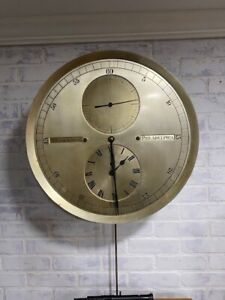
Extremely Rare Astronomical Regulator- 1876 Centennial Gold Medal Winner
SOLD $12,500.00 Sold: Sep 13, 2023 on eBayOriginal Listing Description
Fantastic and enormous astronomical regular built by the German firm Gustov Becker and exhibited at the 1876 Centennials Exhibition where it won a gold medal. The clock was bought by prominent Philidelphia jeweler Samuel Kind, the first U.S. jeweler to sell diamonds. Massive movement and a 20 inch dial.S.KIND & CO. was founded by Samuel Kind in Philadelphia in 1872. Having escaped war torn Europe as a Jewish immigrant just a decade earlier, he had a vision for a new life that began to take shape with the opening of his own store. He became the first purveyor of diamonds in America, cultivating a higher end jewelry buying experience that previously would have only been available in Europe. Through his keen eye and business acumen, he built a jewelry house that would span over a century and became part of the fabric of Philadelphia Samual no doubt saw this magnificent clock at the 1876 Centennial held in Philidelphia, one of approximately twelve Astronomical Regulators made for the Exhibition by the firm of Gustav Becker then the largest clock producer in GermanyA cleaver marketing tool by Gustov Becker was the two sunken subdials which would be very labor intensive to make however this allowed for two further sunken plates for the perspective buyers to put their bussiness name on thus not looking out of place !This was the largest of the clocks produced with a 20" dial and enormous movement and bracket. And it begs to wonder if this was built into the wall of S. Kind Jewelers or perhaps a enormous floor standing clock as our example from Fontains Auctionsfrom a description of a floor standing Gustav Becker Astronomical Regulator clock sold by Fontains AuctionsGustav Becker Astronomical Floor Regulator. Large 16 in. silvered bronze astronomical dial with sweep minutes, 5.5 in. inset sub hour dial above 5.5 in. sub seconds dial, quality blued hands and gilt bronze bezel. Quality brass 8 day weight driven time only movement is signed on the rear plate ?Gustav Becker, Freiburg i/S? (in Schlesien) with ?GB? and crown over anchor mark, front and rear plates are numbered 118702; movement has deadbeat escapement with jeweled pallets, cable barrel exposed on the rear plate, maintaining power, large brass covered weight with quality 4 spoke pulley, long steel pendulum rod with 2 glass jar mercurial compensating pendulum, silvered beat indicator and beat adjustment on the pendulum rod. Exceptional Renaissance Revival carved walnut floor standing case with ebonized highlights has a pierced carved crest with filigree, seashell, turned and carved finials, raised burled panels below, long turned and tapered pendant side pieces with carved florets and incised spandrels in the upper door; the body door has a convex arch at the top under a carved drapery sash and the base has a 1 door compartment. Clock is in excellent condition, case is clean and original finish with no breaks or repairs, 2 top finials are replacements, dial has some wear to the silvering, movement is in running condition. Extremely rare and assumed to be a one of a kind piece, the carved case is of the highest grade and the movement is fine quality. Using the dates for both serial number (1875-1880) and the maker's mark (1852-1877) we were able to determine that this clock was manufactured c.1875-1877, which indicates that it is likely that this clock was manufactured in 1875 for display in the 1876 Centennial International Exhibition held in Philadelphia any617 questions please834 feel free to ask9354 and i will gladly clocks from the 1876 Centennial Exhibition are exceedingly rare and coupled with one of the most famous Philadelphia jewelers make this clock in this condition truly a piece of American History (Condition: Refurbished)
Note: This item has been sold and is no longer available. This page serves as a historical price reference for clocks collectors and appraisers.
Original Listing Description
Fantastic and enormous astronomical regular built by the German firm Gustov Becker and exhibited at the 1876 Centennials Exhibition where it won a gold medal. The clock was bought by prominent Philidelphia jeweler Samuel Kind, the first U.S. jeweler to sell diamonds. Massive movement and a 20 inch dial.S.KIND & CO. was founded by Samuel Kind in Philadelphia in 1872. Having escaped war torn Europe as a Jewish immigrant just a decade earlier, he had a vision for a new life that began to take shape with the opening of his own store. He became the first purveyor of diamonds in America, cultivating a higher end jewelry buying experience that previously would have only been available in Europe. Through his keen eye and business acumen, he built a jewelry house that would span over a century and became part of the fabric of Philadelphia Samual no doubt saw this magnificent clock at the 1876 Centennial held in Philidelphia, one of approximately twelve Astronomical Regulators made for the Exhibition by the firm of Gustav Becker then the largest clock producer in GermanyA cleaver marketing tool by Gustov Becker was the two sunken subdials which would be very labor intensive to make however this allowed for two further sunken plates for the perspective buyers to put their bussiness name on thus not looking out of place !This was the largest of the clocks produced with a 20" dial and enormous movement and bracket. And it begs to wonder if this was built into the wall of S. Kind Jewelers or perhaps a enormous floor standing clock as our example from Fontains Auctionsfrom a description of a floor standing Gustav Becker Astronomical Regulator clock sold by Fontains AuctionsGustav Becker Astronomical Floor Regulator. Large 16 in. silvered bronze astronomical dial with sweep minutes, 5.5 in. inset sub hour dial above 5.5 in. sub seconds dial, quality blued hands and gilt bronze bezel. Quality brass 8 day weight driven time only movement is signed on the rear plate ?Gustav Becker, Freiburg i/S? (in Schlesien) with ?GB? and crown over anchor mark, front and rear plates are numbered 118702; movement has deadbeat escapement with jeweled pallets, cable barrel exposed on the rear plate, maintaining power, large brass covered weight with quality 4 spoke pulley, long steel pendulum rod with 2 glass jar mercurial compensating pendulum, silvered beat indicator and beat adjustment on the pendulum rod. Exceptional Renaissance Revival carved walnut floor standing case with ebonized highlights has a pierced carved crest with filigree, seashell, turned and carved finials, raised burled panels below, long turned and tapered pendant side pieces with carved florets and incised spandrels in the upper door; the body door has a convex arch at the top under a carved drapery sash and the base has a 1 door compartment. Clock is in excellent condition, case is clean and original finish with no breaks or repairs, 2 top finials are replacements, dial has some wear to the silvering, movement is in running condition. Extremely rare and assumed to be a one of a kind piece, the carved case is of the highest grade and the movement is fine quality. Using the dates for both serial number (1875-1880) and the maker's mark (1852-1877) we were able to determine that this clock was manufactured c.1875-1877, which indicates that it is likely that this clock was manufactured in 1875 for display in the 1876 Centennial International Exhibition held in Philadelphia any617 questions please834 feel free to ask9354 and i will gladly clocks from the 1876 Centennial Exhibition are exceedingly rare and coupled with one of the most famous Philadelphia jewelers make this clock in this condition truly a piece of American History (Condition: Refurbished)
Note: This item has been sold and is no longer available. This page serves as a historical price reference for clocks collectors and appraisers.