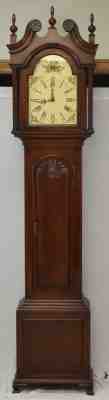
Store Item:Colonial Company John Goodard Mahogany Chippendale Grandfather Clock Henry Ford Collection Rare<br Description: nbsp;Colonial Company John Goodard Mahogany Chippendale Grandfather Clock Henry Ford Collection nbsp;High End Colonial Manufacturing reproduction of a tall case clock from the Henry Ford Collection from a clock displayed at Edison Institute at Dearborn, Michigan. Clock features three flame finials sitting on ovals with center broken arch pediment flanked by two rosette nbsp;medallions painted porcelain dial with birds and flowers, mahogany case with key lock door
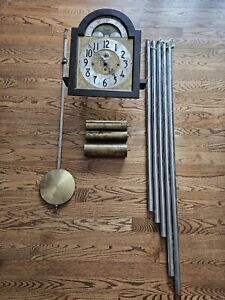
Brief history on Colonial and Herschede collaboration. The Herschede Hall clock company shipped Herschede made movements to Colonial Clock Manufacturing Co. from July 1915 until 1925 during WWI. It's an antique clock kit and it's over 100 years old!! The serial number of the Herschede movement is 12834.The listing is for a complete antique Colonial by Herschede tubular 5 tube grandfather clock kit. The kit comes with a cable driven movement and it comes complete with a wood bracket, 3 cables with pulleys, pendulum leader, 5 tubes, 3 original Herschede weights and original pendulum with suspension spring and a replacement crank key. The movement is complete it is untested. It might require cleaning and or oiling since clock was stored for an extended period of time. Please note, one of the cables is loose and might require a replacement. The weights are in a good condition with some original patina, that can be cleaned if desired. The pendulum is in a good condition with some light imperfections due to the age and a few small dents. Please check all pictures for the condition. The tubes are in a very good condition with some light imperfections due to the age. They might require cleaning to bring it back to original condition. These are original heavy duty tubes, that were manufactured over 100 years ago. We offer returns within 14 days, however buyers are responsible for all shipping charges. Please note, that the dial and some other parts will be separated from the movement for shipping purposes and you will have to reattach it. We will include all parts. Please note, that shipping within US is $169.99 due to a multiple packages and the weight. The package with tubes is oversized and UPS charges extra for it. Please note, that we can ship the item only within continental US. UPS charges triple amount to deliver to Hawaii or Puerto Rico. The item will require signature confirmation. Please ask questions before your purchase. Thank you (Condition: Pre-Owned)
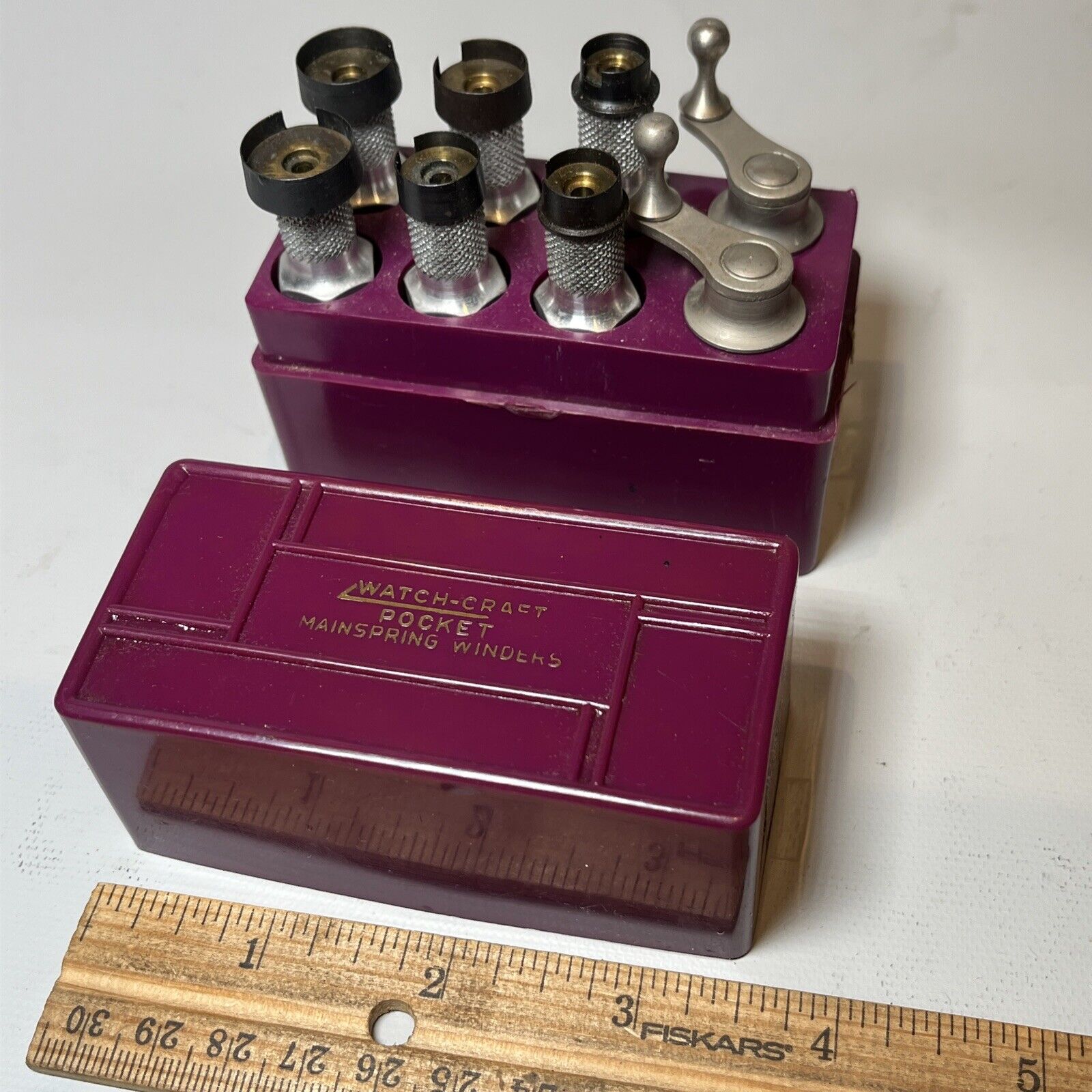
Vintage WATCHCRAFT (Watch-Craft) "POCKET MAINSPRING WINDERS" Set of 6 in Case!From the estate of a retired watchmakerThis is a Buy It Now sale and payment with be due at time of sale. I gladly accept PayPal. Thanks for looking! We take great pride in customer satisfaction and accurate descriptions. If you receive the item and it is not as described, please let us know immediately so we may rectify the issue to your satisfaction. Your positive feedback and your satisfaction are very important to us! We sell clocks to professionals, hobbyists and collectors who have experience in repairs.. If you are just trying to fix a watch or clock without knowledge of how to do so, we suggest that you seek out professional help. This can lead to be an expensive proposition if you should not have the knowledge to repair or restore your clock.Make sure you join the National Association of Watch and Clock Collectors. Its a great way to meet other clockmakers (Anchor Saddle, Escape Gear, Keeper, Crutch, Suspension, Spring, Pendulum, Hammer Rod, Winding Arbor, Count Wheel, Count Lever, Fan Fly, Wheel, Pallet, Jewel, Main Wheel, Mainspring, Barrel, Driving Wheel. Locking Wheel, Barrel, Chime Warning Wheel, Gathering Pallet, Cannon Pinion, Time Intermediate Wheel, Rack Hook, Pin Barrel, Buffer Spring Cam Wheel, Fly Pinion, Ratchet, Click, Release, Lug, Hook, Snail, Nuts, Pins, Bushings, Arbor, Hairsprings, Bracket, Mount, Gear or Sprocket) needed for your repair or restoration This clock movement may also work with other German Clocks including Wall Mounts, Grandfather, Shelf, Column, Ogee, Steeple, Gothic, Acorn, Hump Back, Porcelain, Carriage, Cabinet, Gingerbread, Mission, Seth Thomas, Regulator, Banjo, Gallery, Looking Glass, Lyre, Calender, Cuckoo, Bracket, Behive, Cottage, Scroll, Grecian, Gilbert, Atkins, Iron Front, Waterbury, Parlor, Pedimented, Camel Back, Welch, Ansoniamonarch, Sessions, Chimes, Pendulums, Schatz, Kieningern, Haller & Kundo Clockmaking, Clockmakers, tools, Clockmaker's, Watchmaker's, Collectors, Dealers Selection clocksmith - someone whose occupation is making or repairing clocks and watches clockmaker artisan, journeyman, artificer, craftsman - a skilled worker who practices some trade or handicraft Restoration, Restore, Repair, Parts, Repurpose Supplies Salvage Hardware Repurposed List of clock Abbott, Ansonia Attleboro Bailey Banks & Biddle; Birge, Gilbert Birge, Mallory Birge, Peck Boardman & Dunbar Boardman & Wells Brewster & Ingrahams Bridgeport Chauncey Boardman Chauncey Jerome Chelsea Chicago Colonial of Zeeland David Wood Dyer, Wadsworth E. Howard E & A Ingrahams Elgin Elias Ingraham; Eli Terry E N Welch F Kroeber Franklin General Electric General Time H.C. Thompson Harris & Mallow, Heman Clark Herschede Hotchkiss and Benedict Howard Miller Jennings Brothers Joyce Bros. & Co. Lawson Luman Watson Masterclock Munger and Benedict National Time and Signal New England New Haven Parker & Whipple Pomeroy, Ray and Ingraham Reeves Ridgeway Riley Whiting; Samuel Whiting; Salem Sangamo Self Winding Clock Company; Sempire Seth Thomas Sessions Standard Electric Time Company United Waltham Warren Waterbury Western, Westclox; William L Gilbert Williams, Orton & Preston Wood Art Weursch Elderhorst Bells Clocks as we know them today, with dials indicating the hour and minute of the corresponding time, originated in medieval Europe and were predominantly installed in churches and town halls. It wasn’t until the 19th and 20th centuries that clocks evolved at an exceedingly swift rate, resulting in greater accuracy, more refined designs, and more frequent appearances in people’s homes. In both the United States and internationally astrological, tall-case, year-long runners, and skeleton clocks are in demand. “E. Howard and Seth Thomas are two of the bigger names that collectors are seeking out right now, Buyers of antique and vintage clocks today range from collectors who own hundreds of them, to the retail buyers who’ve been looking for the right grandfather clock to display in their living room. “Collectors pay close attention to rarity and condition, For early American clocks, they look for original glass tablets, original painted dials, and the original finish or actual wood case. With European clocks, specialists tend to be a bit more forgiving in terms of condition because it has more to do with the movements and gears. A replaced gear on a European clock, for example, may be more acceptable than a replaced tablet or dial on an American clock. Important 19th-Century Styles By the 19th century, recognizable innovations and styles began to emerge across Europe. In France, for example, clocks were fitted with extravagant cases mirroring trends in interior design, and by 1850 carriage clocks decorated with Limoges enamel, porcelain, and gilt metal were becoming exceedingly popular. Meanwhile, Germany specialized in making affordable brass and wooden clocks, most notably cuckoo clocks, which were made in the Black Forest region and exported across Europe. Skeleton clocks were the characteristic choice for British households, churches, and government buildings, as were clocks decorated with Gothic-inspired cases and architectural elements, exemplified most famously by Big Ben. Antique Vienna and English clocks from 1780 to 1920, the most famous and collectible makers produced clocks between 1700 and 1890. “This was the great era of clockmaking, and a time that sparked lots of novelties and inventions in clock movements and cases. Important 20th-Century Styles Twentieth century clocks typically drew inspiration from earlier styles, although the U.S. made, electrically powered “Eureka” clock is especially indicative of the years leading up to the First World War. The heyday of clock manufacturing took place in the first half of the century, and by the 1950s clocks became increasingly minimalistic in design, reflecting developments in modern art and architecture. Today, clocks are available at a wide range of prices, styles, and sizes, evidencing the long-lived history of these highly valued, sophisticated timekeeping devices High end valuable clocks tend to be handmade, rare, or limited edition pieces made or decorated with precious materials, such as gold, diamonds, rubies, mother of pearl enamel, porcelain, and high-quality wood. Clocks made by important designers, like Abraham Louis Breguet, or reputable manufacturing companies, like Ansonia, are also highly prized as premium collectible pieces. Antique Wall Clocks Wall clocks, which were first made during the 16th and 17th centuries, are among the earliest styles of clocks designed for display within the home. They not only tell time but also serve as sculptural works of art adorning the room. One of the most fashionable styles of antique wall clocks is the Ansonia hanging clock, made by Ansonia Clock Company, which originated in Ansonia, Connecticut in 1851 and moved to Brooklyn, New York in 1878. Ansonia clocks are usually made of a combination of brass and high-quality wood and decorated with ornately executed designs, such as mini-friezes, classicizing figures, and floral and geometric designs inspired by ancient Greek architecture. Bidermeier clocks, made in Germany and Austria between 1815 and 1848, are another popular type of antique wall clock. Produced primarily for a burgeoning middle class knowledgable of the value of furniture and interior design, Bidermeier clocks exhibit simple yet elegant features. One of the main identifying characteristics of this refined style is the juxtaposition between the sleek, straight lines of the clock’s torso and the delicate curves of the baroque and gothic motifs decorating the upper and lower portions of the case. Vintage Mantel Clocks Mantel clocks were first made in France and were typically placed above the fireplace alongside vases or sculptural figurines. Also known as chamber clocks, early mantel clocks oftentimes had handles, enhancing their practical function as portable timekeeping devices that could be easily picked up and moved from mantel to bookshelf to tabletop; however, later versions departed from this design. Vintage mantel clocks, especially those made during the Art Deco period and mid-century, are valued today for their simple yet elegant geometric designs. Antique Cuckoo Clocks Cuckoo clocks were first made during the 18th century in the Black Forest region of southwestern Germany, although they also have a long history in Switzerland and Austria. These clocks are of course famous for the automaton cuckoo bird that moves in tandem with musical notes each time the clock strikes the hour. Cuckoo clocks are prized for their lively, interactive quality and handmade, intricately carved designs. Antique versions are typically decorated with forest and hunting scenes and include animal motifs, most notably hounds, deer, rabbits, pheasants, and other woodland creatures. Antique Grandfather Clocks Grandfather clocks are named after the 1876 song “My Grandfather’s Clock” (“My grandfather’s clock was too large for the shelf, So it stood ninety years on the floor”). Also called long-case, tall-case clocks, and floor clocks, grandfather clocks are freestanding, weight-driven pendulum clocks, often outfitted with elaborate ornamentation, especially on the hood of the case. Invented by the English clockmaker William Clement in 1670, the grandfather clock quickly became popular across Europe and assumed a variety of forms. American grandfather clocks, such as those made in 19th-century New England, are usually eight feet tall and exhibit a wide, sturdy base, whereas French clocks often have slim bodies and flat or slightly rounded hoods. Many antique grandfather clocks include highly detailed metal dials illustrating the passage of the sun and phases of the moon. (Condition: Pre-Owned)