

Rare And Collectible Clocks : Norway Clock Price List
average value
-
low
-high
-Found 3 out of 76,752 items matching 'Norway'
Sold on eBay September 18th, 2023
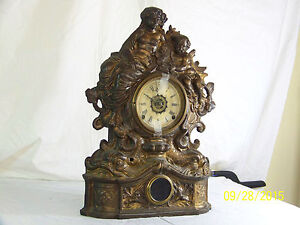
Antique 1850's Waterbury Bronze/Metal Mantle / Floor Clock
Antique c19th Century Art Nouveau Style Waterbury Clock Co., Bronze Metal Cast Iron Shelf mantle Clock. This is a very large ornate clock. It is complete with pendulum but is missing key! This clock has a wood removable backing which gives access to the workings of the clock.The front face of clock is in roman numerials.The face has wear conducive to use and age. The bottom glass window opens and is where the pendulum shows and also shows Waterbury Clock Company Paper Listing. Sold As Is! Excellent item! COMPLETE! MEASURES: 19 1/2" x 14 1/2" x 4". PLEASE WAIT FOR INVOICE HISTORY: In 1854, Waterbury, Connecticut based brass manufacturer Benedict & Burnham created Waterbury Clock Company to manufacture clocks using brass wheels and gears. Waterbury Clock Company was legally incorporated on March 27, 1857, as an independent business with $60,000 in capital.The American clock industry, with scores of companies located in Connecticut's Naugatuck Valley, was producing millions of clocks, earning the region the nickname, "Switzerland of America". The Waterbury Clock Company was one of the largest producers for both domestic sales and export, primarily to Europe. Today its successor, Timex Group USA, Inc. is the only remaining watch company in the region. Originally, the company produced clocks as less expensive alternatives to the high-end European counterparts of the time. In 1887 the company began experimenting with its product line, leading to the creation of the large Jumbo pocket watch, invented by Archibald Bannatyne and named after the famous P. T. Barnum elephant. The Jumbo was put on the market in New York City on a trial basis, catching the attention of Robert H. Ingersoll, a salesman and eventual marketing pioneer. During the turn of the century, Waterbury Clock Company produced millions of pocket watches for the newly created partnership of Robert and his brother Charles, Robert H. Ingersoll & Bro., under their own brand name. In 1896, Ingersoll introduced the Ingersoll Yankee, a dollar pocket watch supplied by Waterbury Clock Company. These watches gained such great popularity that they became known as "the watch that made the dollar famous."In 1877, a new prototype was introduced to Benedict and Burnham for an inexpensive pocket watch made of 58 parts, mostly made of punched sheet brass. They immediately set aside an unused portion of their machine shop and began producing the Long Wind at a rate of 200 per day by 1878. The department quickly outgrew its space in the plant, so with a capital of $400,000 Waterbury Clock's sister company Waterbury Watch Company was incorporated by Benedict & Burnham in 1880 to manufacture and sell inexpensive watches and other timepieces. Waterbury Watch started out very successfully in its early days, employing hundreds of women for their "slender fingers" and "delicate manipulation," having become the largest volume producer of watches in the world by 1888.Due to poor sales techniques, where jobbers and salesmen gave away much of the Waterbury Watch products as loss leaders with little regard to the company's future, thereby cheapening the products' perceived value, Waterbury Watch quickly fell into bankruptcy. In a last attempt to salvage the company, Waterbury Watch began to produce higher-end watch models which only created more demand on a workforce unable to keep up with the complexity of the new watches using several hundred parts. The company was finally reorganized as the New England Watch Company in 1898 as its London sales office was placed into liquidation. The company continued to focus on high-priced watch models and eventually fell into receivership, discontinuing business in July 1912. Robert H. Ingersoll & Bro. bought the Waterbury plant and began manufacturing Ingersoll Watches there in 1914. With the American entry into World War I there were new demands for timepiece design. Artillery gunners needed an easy way to calculate and read time while still being able to work the guns. The Waterbury Clock Company met this need by modifying the small Ingersoll ladies' Midget pocket watch to become military-issue wristwatches — lugs were added for a canvas strap, the crown was repositioned to 3 o'clock, hands and numbers were made luminescent for nighttime readability, thus making one of the first wrist watches. In 1922, Waterbury Clock Company purchased the Robert H. Ingersoll & Bro. company for $1,500,000, which had gone bankrupt the previous year due to the post-war recession, thereby inheriting all of Ingersoll's and Waterbury Watch's assets and facilities. Unable to deliver on Ingersoll's guarantee of quality in Europe due to the Great Depression, Waterbury Clock sold the London-based Ingersoll, Ltd. to its Board of Directors in 1930, making it a wholly British-owned enterprise. The "powerful Ingersoll brand name" was continued in the United States by Waterbury Clock into the 1950s. No longer part of Waterbury Clock Company, Ingersoll Ltd. continued to produce the Ingersoll watch brand independently for the European and other international markets. Following the Great Depression and a period of hardship for the company, Waterbury Clock Company regained its identity in the consumer market. In 1930, a license agreement was reached with Walt Disney, resulting in the production of the famous Mickey Mouse watches and clocks under the Ingersoll brand name. The new Mickey Mouse timepieces were introduced to the public at the Chicago World's Fair in June 1933 and quickly became the company's first million-dollar line, saving it from financial disaster. In 1940, Thomas Olsen (owner and operator of Fred. Olsen Shipping Co.) and Joakim Lehmkuhl fled Norway with their families because of the Nazi invasion Eventually they came to the United States seeking investments to assist in the war effort. In 1941, Olsen and Lehmkuhl purchased controlling interest in Waterbury Clock Company, with Thomas Olsen becoming Chairman. Though the company had fallen on hard times during the Great Depression it still had the manufacturing capability to make large numbers of timing devices. Mr. Lehmkuhl, who had studied business and engineering at Harvard and MIT, was appointed President by Olsen and, under his direction, the company became the largest producer of fuse timers for precision defense products in the United States. A new concrete plant was built in nearby Middlebury, Connecticut in 88 days in 1942 for the high-volume production of precision timers. In August 1943, the Army-Navy "E" Award for excellence was awarded by the United States Under-Secretary of War to Waterbury Clock Company for the "Anglo-American fuse". As a result of this success shareholders in the following December voted to rename the company to United States Time Corporation.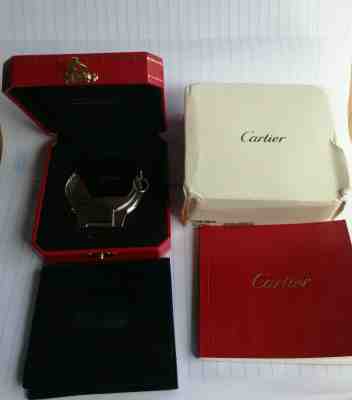
Sold on eBay Oct, 2nd 2020
CARTIER BALLON BLEU TRAVEL ALARM CLOCK REF 3038. BOX, WARRANTY, POUCH NEVER USED
<br /><br /><br />PLEASE, CONFIRM WITH THE BUYER IF I CAN SHIP TO YOUR COUNTRY MY POSTAL SERVICE ONLY SEND TO THE FOLLOWING COUNTRIES:<br />UNITED STATES. GERMANY. ARGENTINA. AUSTRIAN. BELGIUM. BULGARI. CHILE. CHINA. KOREA. CROATIA. DENMARK. EGYPT. ESLOVAQUIA. ESLOVENIA. SPAIN. ESTONIA. FINLAND. FRANCE. UNITED KINGDOM. HOLLAND. HONG KONG. HUNGARY. INDIA. ISRAEL. ITALY. JAPAN. LETONIA. LITUANIA. LUXEMBOURG. MEXICO. NORWAY. POLAND. PORTUGAL. CZECH REPUBLIC. RUMANIA. SENEGAL. SERBIA. SWEDEN. SWITZERLAND. THAILAND. VIETNAM br /><br />NEW COUNTRIES: ANDORRA. CANADA. COSTA RICA. GREECE.
Sold on eBay January 1st, 2025